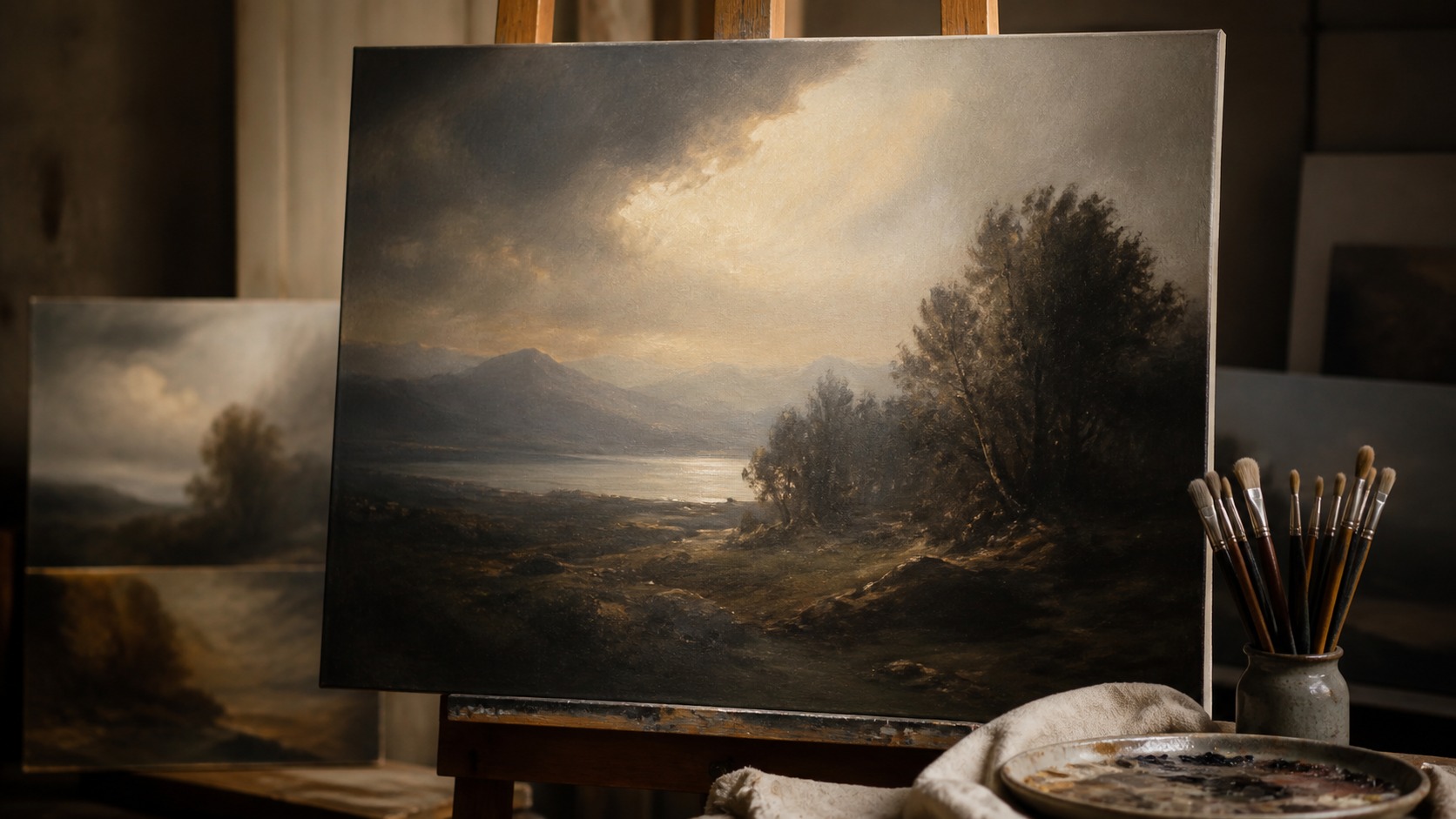
Atmosphere Happens When Light, Shadow, and Tone Work as One
Atmospheric painting makes a canvas feel as if it has air, memory, weather, silence, or emotional pressure inside it. It comes from the relationship between light, shadow, and tone more than from subject matter alone. A simple landscape, room, figure, or abstract field can feel immersive when values are controlled, edges breathe, and color temperature supports the mood. The art of atmosphere is learning how to make viewers feel the space before they finish identifying the objects.
A: It is the felt air, mood, depth, and emotional climate of the work.
A: No, interiors, portraits, still lifes, and abstracts can all use it.
A: Tone, soft edges, controlled light, and shadow relationships.
A: No, atmosphere often improves when some detail is withheld.
A: Usually no; atmospheric shadows often contain color and variation.
A: Tone sets whether the canvas feels airy, balanced, intimate, or heavy.
A: Varied edges let forms merge into air, light, and distance.
A: Yes, uncontrolled saturation can break a subtle mood.
A: Step back and see whether the whole canvas feels unified.
A: The viewer should feel the space before analyzing the objects.
Tone Creates the Emotional Climate
Tone gives a painting its value climate. A high-key canvas with pale values may feel open, airy, or fragile, while a low-key canvas with deep values may feel intimate, solemn, or mysterious. Mid-key paintings can feel balanced and observational. The tonal range sets the emotional climate before details arrive.
Relationships create atmosphere more than isolated colors do. A blue can feel bright or somber depending on the values around it. A shadow can feel warm, cool, heavy, or transparent depending on nearby light. Tone gives color its emotional context.
Artists can plan tone like music. Some paintings need a narrow, quiet range; others need dramatic leaps from dark to light. Neither approach is better by default. The tonal structure should match the experience the canvas wants to create.
Tonal climate should be chosen before chasing detail. A painting meant to feel misty, heavy, luminous, or quiet needs a value world that supports that feeling. Detail added against the wrong tone can feel decorative but emotionally weak. Atmosphere begins with the broadest decision.
Subject choice can also follow the tonal climate. A high-key atmosphere may suit fog, pale interiors, or reflective water, while a low-key atmosphere may suit woods, night rooms, or stormy skies. Choosing subject and tone together makes the mood more believable. Atmosphere weakens when they contradict unintentionally.
Atmosphere also depends on restraint in detail. Too many equally described objects can make the canvas feel cataloged rather than felt. Choosing which details dissolve allows the viewer to sense distance, air, and memory. The painting becomes more immersive when it does not explain everything.
Light Gives Atmosphere a Source
Illumination tells the viewer what kind of world the painting inhabits. Mist diffuses light, sunset warms it, moonlight cools it, and interior lamps make it feel intimate. A believable light source gives atmosphere a physical cause. The mood becomes easier to enter because it seems to belong to the scene.
Indirect illumination often creates the richest atmosphere. It may glow through clouds, bounce from water, seep through a doorway, or dissolve across a wall. That softness lets edges relax and tones merge gradually. The viewer feels air between forms.
Direct light can still be atmospheric when used with restraint. A beam across a dark room, a sharp highlight on water, or a bright clearing in a storm can create powerful mood. The key is surrounding that light with tonal support. Atmosphere needs context around brightness.
Everything touched by light should feel related. If highlights, shadows, and color temperatures do not agree, the atmosphere feels pasted on. Consistency lets the painting become one world. The viewer trusts the mood because the light behaves.
Weather can be implied without being shown literally. A softened glow, muted distance, or cool reflected light can suggest fog, rain, winter air, or evening calm. The viewer feels conditions through light behavior. Atmosphere often works through implication.
In atmospheric work, light often has a path. It enters, spreads, fades, and meets resistance from objects or weather. Painting that path helps the viewer feel space. The light should not simply brighten objects; it should move through the world.
The source of light should be emotionally believable even when it is not visible. A hidden sun, lamp, window, or clearing can still organize the whole canvas. Viewers accept atmosphere more readily when the light seems to come from somewhere. Mystery is stronger when it has structure.
Uneven contact makes atmospheric light more convincing. A wall, hill, table, or cloud bank can catch light gradually, giving the viewer a sense of volume. Even simple subjects feel richer when illumination travels across them. The canvas gains air through transition.
Shadow Adds Depth, Mystery, and Weight
Depth enters atmospheric painting through shadow. It hides some information, slows the viewer down, and gives illuminated areas more significance. A canvas without shadow can feel weightless, while a canvas with thoughtful shadow can feel inhabited. Darkness makes light matter.
Rarely is atmospheric shadow empty black. It contains softened edges, reflected color, partial forms, and value shifts that imply space. The viewer senses more than they can fully see. That suggestion is often more powerful than explicit detail.
Emotional pressure can also come from shadow placement. A dark foreground may make a distant light feel hopeful, while a heavy sky can make a landscape feel expectant. The placement of shadow affects narrative even without figures. Tone and placement turn darkness into feeling.
Inside shadow, the viewer gets privacy within the painting. Not everything is exposed, so the eye can wander and imagine. This is one reason atmospheric paintings often feel personal. They leave space for the viewer to bring memory into the scene.
Shadow can suggest history. A dim corner, obscured doorway, or soft tree line may imply what happened before the viewer arrived. That suggestion gives atmosphere emotional depth. Not every story needs a visible character.
Deep shadow can make luminous passages feel earned. If the entire canvas is evenly lit, highlights may have no emotional force. Darkness gives the eye contrast, rest, and anticipation. The glow matters because something around it withholds itself.
Edges Let Air Enter the Painting
Edge control sits at the center of atmosphere. Hard edges pull objects forward, while soft or lost edges let them merge into light, mist, shadow, or distance. A painting with every edge equally sharp may feel cut out rather than immersive. Air appears when edges vary.
Lost edges are especially useful. When a form disappears into a nearby value, the viewer completes it mentally. That participation makes the painting feel alive. Atmosphere often depends on what is withheld.
Soft edges should still be controlled. If everything dissolves, the painting can lose structure. Keep enough firm edges around the focal area to anchor the viewer. Atmosphere works best when clarity and ambiguity share the canvas.
Texture interacts with edges. Heavy brushwork can bring a passage forward, while thin veils of paint can make it recede. Surface handling should support the tonal plan. The physical paint becomes part of the air.
Edges should vary according to importance. The focal area may need firmer edges, while distant or emotional passages can dissolve. This hierarchy keeps atmosphere from becoming blur. Softness has to be organized.
Near the focal point, edges can remain firmer while outer passages dissolve. This gives the viewer an anchor without destroying the larger mood. The balance between edge and haze is delicate. Atmosphere is not the same as blur.
Edge variety can be planned like a map. Mark where the viewer needs certainty, where forms can soften, and where shapes can disappear. This prevents atmospheric painting from becoming accidental haze. Softness should be chosen as deliberately as sharpness.
Color Temperature Shapes the Mood
Warm and cool relationships give atmosphere emotional nuance. Warm light against cool shadow can feel intimate, dramatic, or nostalgic. Cool light over warm earth can feel fresh or distant. Temperature changes help viewers feel time of day and emotional tone.
Restrained color often holds atmosphere together. Too many saturated colors can break the mood unless the painting is designed around that intensity. Limited palettes allow small shifts to matter more. Subtle color can be more atmospheric than loud color.
Neutral passages are not empty. Grays, browns, and muted colors can carry enormous emotional weight when their temperature is carefully tuned. A warm gray and a cool gray can tell different stories. Atmosphere often lives in these quiet differences.
Temperature shifts should be subtle enough to belong to the same world. A warm highlight, cool distance, or neutral shadow can enrich the mood, but unrelated color jumps break the spell. Atmospheric color is usually relational. Each temperature choice affects the others.
Plane separation can also come from temperature. A cooler distance, warmer foreground, or neutral middle ground can create space while preserving a limited palette. These shifts should be subtle enough to feel atmospheric rather than diagrammatic. Small temperature changes can do large emotional work.
Temperature relationships can imply season and time. Cool grays may suggest winter or distance, while warm muted light can suggest late afternoon or memory. These associations do not need to be literal. The viewer feels them through the painting's climate.
Limited palettes can make atmosphere easier to sustain. When colors are restrained, small warm and cool shifts become meaningful rather than lost in noise. This does not mean the painting must be dull. It means color serves the mood instead of competing with it.
Atmospheric palettes often rely on near-neutrals that lean warm or cool. These small leanings can suggest damp air, old light, distant hills, or interior shadow. The differences may be quiet, but they are not accidental. Subtle temperature is one of atmosphere's most useful languages.
Transform the Canvas by Controlling the Whole Field
Focusing only on the subject can make atmosphere fail. The surrounding field, background, corners, and quiet passages all contribute to the feeling of space. Every area of the canvas should belong to the same tonal world. The viewer experiences atmosphere as a whole, not as a spot effect.
Step back often while working or evaluating. Atmosphere is easier to judge from distance because details stop distracting from the larger light and tone pattern. If the canvas reads as a unified mood before the subject is fully parsed, the atmosphere is strong. Distance reveals the painting's weather.
Ultimately, the transformation is emotional. Light invites the viewer in, shadow creates depth, tone sets climate, edges let air move, and color temperature gives the mood its flavor. When those elements cooperate, the canvas feels larger than its subject. It becomes a place the viewer can enter.
Corners matter more than many artists expect. If they are too busy, they pull attention away from the atmospheric field. If they are ignored, the painting can feel unfinished. Quiet corners can hold the mood in place.
Success arrives when atmosphere makes viewers slow down. They may not know whether tone, edge, temperature, or shadow caused the feeling, but they sense a coherent world. That felt coherence is the transformation. The canvas becomes an environment rather than an image alone.
Even dramatic paintings can feel quiet when atmosphere carries the whole field. The mood is not held by a single effect. That unity is what makes viewers linger. They are not only looking at a scene; they are entering a condition.
Atmosphere should be checked before the final accents are added. A few bright marks can enliven a canvas, but too many can puncture the mood. Step back and protect the larger feeling. The most atmospheric choice may be to leave a passage quiet.
Display can strengthen or weaken atmospheric work. Harsh glare may flatten subtle tones, while dim light can bury delicate transitions. A canvas built on atmosphere needs viewing conditions that preserve nuance. The room should let the quiet parts speak.
For the final atmospheric check, ignore the subject for a moment. Ask whether the canvas has a felt climate before naming the objects. If the climate is clear, the painting has begun to transform space. If not, return to tone, edges, and light.