The Most Misunderstood Objects in the Universe
Black holes are among the most fascinating and mysterious phenomena in the universe. They appear constantly in science fiction, documentaries, and headlines about new cosmic discoveries. In popular culture, they are often portrayed as destructive cosmic vacuums that roam the universe, swallowing everything in their path. The reality is both more complex and far more interesting. In physics, a black hole is not a hole at all. It is a region of space where gravity has become so intense that nothing, not even light, can escape once it crosses a critical boundary. This extreme gravity results from an enormous amount of mass compressed into an incredibly small space. Black holes were once considered purely theoretical. Today, they are one of the most studied objects in astrophysics. Scientists have photographed them, mapped their influence on surrounding stars, and detected ripples in space-time produced when they collide. Far from being simple cosmic monsters, black holes are engines of extreme physics that help scientists understand gravity, matter, and the very structure of the universe. Understanding how black holes actually work requires separating scientific fact from persistent myths.
A: No. Their gravity only affects nearby regions unless something gets very close.
A: Only if one passed extremely close to our solar system.
A: Intense tidal forces would stretch and compress matter dramatically.
A: Not literally. They are extremely dense regions where gravity dominates.
A: Hawking radiation suggests they slowly lose mass and may eventually evaporate.
A: Some theories connect them, but wormholes remain hypothetical.
A: Yes. A region called the photon sphere allows light to circle the hole.
A: By studying the motion of nearby stars and radiation from accretion disks.
A: None close enough to pose danger to our solar system.
A: They test the limits of gravity, relativity, and quantum physics.
The Birth of a Black Hole
Most black holes form from the death of massive stars. When a star many times heavier than the Sun runs out of nuclear fuel, it can no longer support itself against the crushing force of gravity. The star collapses inward under its own weight.
During this collapse, the outer layers of the star explode outward in a spectacular event called a supernova. What remains at the center continues collapsing. If the remaining core is heavy enough, gravity compresses it beyond the limits of neutron stars. The matter collapses to a point of extraordinary density, forming a black hole.
The boundary surrounding this region is called the event horizon. It marks the distance at which escape becomes impossible. Once any particle, photon, or spacecraft crosses this threshold, the gravitational pull is too strong to overcome. Importantly, the event horizon is not a physical surface. It is simply a boundary in space-time. From the outside, it behaves like a one-way door.
Gravity Turned Up to the Extreme
To understand black holes, one must first understand gravity at its most intense. According to Einstein’s theory of general relativity, gravity is not simply a force pulling objects together. Instead, massive objects bend the fabric of space-time around them. Planets orbit stars because they move through this curved geometry.
A black hole represents the ultimate expression of this effect. Its mass curves space time so severely that every possible path leads inward. If Earth were compressed to the size of a marble, its gravity would become strong enough to create a black hole. The mass itself would not change. Only the density would increase dramatically.
This reveals an important truth about black holes. Their gravitational influence on distant objects is no different than that of any other object with the same mass. If the Sun magically became a black hole while keeping the same mass, the planets would continue orbiting exactly as they do today. Black holes do not roam the universe devouring everything. Their gravity only dominates nearby space.
The Event Horizon and the Point of No Return
The event horizon defines the most famous feature of a black hole. At this boundary, the escape velocity equals the speed of light. Since nothing can travel faster than light, escape becomes impossible. Any matter or radiation crossing this limit is permanently trapped.
From the perspective of a distant observer, something falling toward the event horizon appears to slow down dramatically. Light emitted from the falling object becomes stretched into longer wavelengths. Eventually, it fades into invisibility.
However, from the viewpoint of the falling object itself, nothing special happens at the event horizon. The traveler would cross the boundary without noticing a sudden change. The real danger lies deeper inside.
The strange behavior observed at the event horizon arises because time itself becomes distorted by extreme gravity. Near a black hole, time flows more slowly compared with distant regions of space. This phenomenon is called gravitational time dilation and has been experimentally confirmed near less extreme gravitational fields such as Earth and neutron stars.
The Singularity Mystery
At the center of a black hole lies what physicists call a singularity. A singularity represents a point where density becomes infinite and known laws of physics break down. General relativity predicts that all the mass of the collapsed star is crushed into an infinitely small point. However, most scientists believe this description is incomplete. When physical theories produce infinities, it usually signals that the theory itself has reached its limits.
Inside a black hole, gravity becomes so extreme that quantum mechanics must also play a role. Yet modern physics still lacks a fully developed theory that combines quantum mechanics with gravity. This missing framework is often referred to as quantum gravity. Because of this gap in knowledge, the true nature of the singularity remains one of the greatest mysteries in science.
Spaghettification: The Reality of Falling In
One of the strangest effects associated with black holes is known as tidal stretching, often nicknamed spaghettification.
Gravity becomes stronger as one approaches the black hole. The difference in gravitational pull between a person’s feet and head can become enormous. The feet are pulled more strongly than the head, stretching the body into a long thin shape.
For smaller black holes, this stretching effect becomes lethal well before the event horizon is reached. The tidal forces would tear apart any object long before it could cross the boundary.
Interestingly, supermassive black holes behave differently. These giants, which sit at the centers of galaxies, have event horizons so large that tidal forces at the boundary are relatively mild. A person could theoretically cross the horizon without immediate destruction, though survival deeper inside would still be impossible.
Supermassive Giants at the Centers of Galaxies
Astronomers now believe that nearly every large galaxy contains a supermassive black hole at its center.
These black holes can weigh millions or even billions of times the mass of the Sun. The one at the center of our Milky Way galaxy, known as Sagittarius A star, has a mass roughly four million times that of our Sun.
Despite their immense mass, these objects are surprisingly compact. The entire event horizon of Sagittarius A star is smaller than the orbit of Mercury.
Supermassive black holes play a crucial role in shaping galaxies. Their gravitational influence controls the motion of stars near the galactic center. They also power some of the most energetic phenomena in the universe.
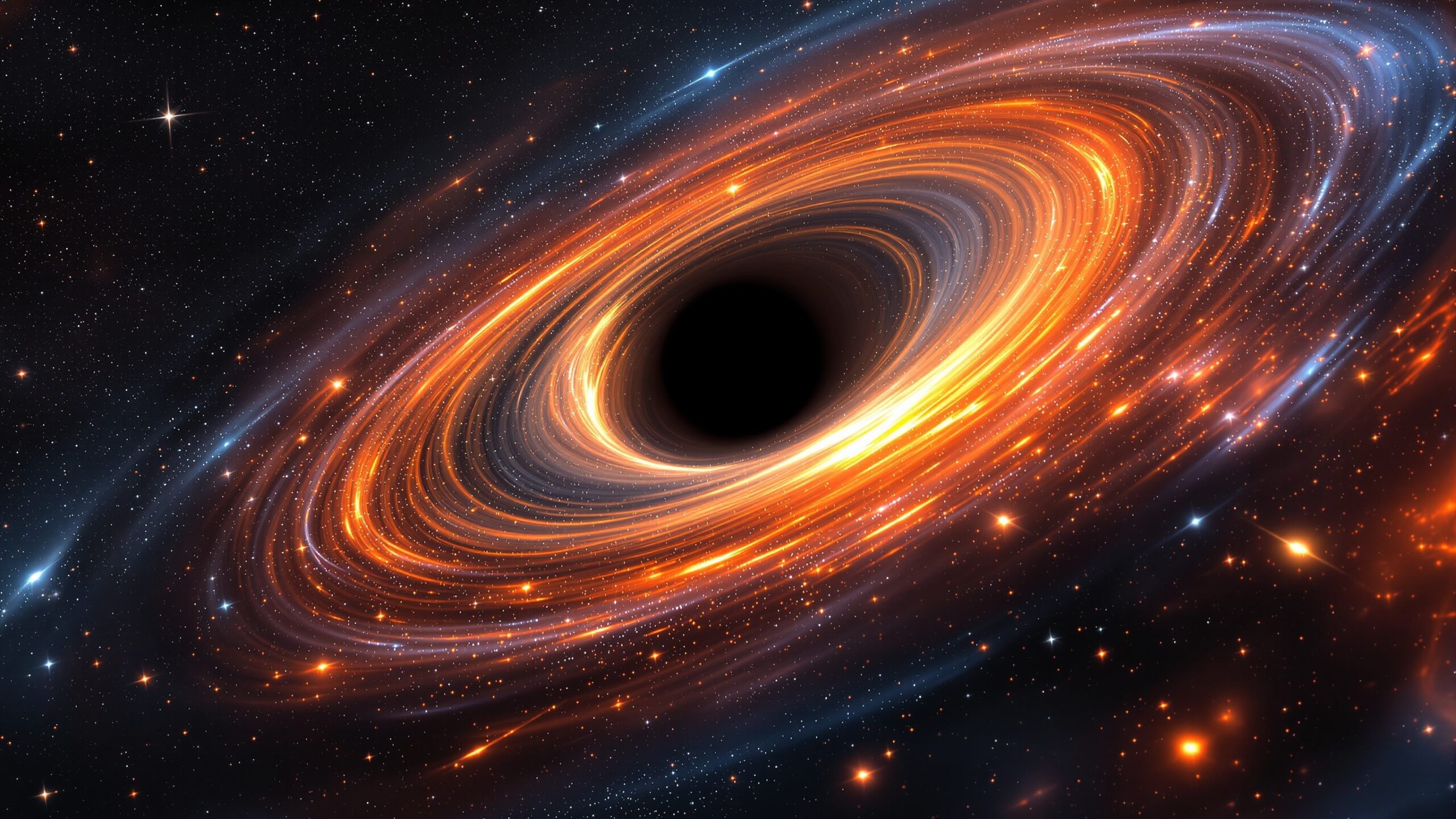
When matter spirals toward a supermassive black hole, it forms a rapidly spinning disk known as an accretion disk. Friction and magnetic forces heat this material to incredible temperatures, causing it to shine brighter than entire galaxies.
In some cases, enormous jets of high energy particles shoot outward from the poles of the black hole at near light speed. These jets can extend for thousands of light years into space.
The First Photograph of a Black Hole
For decades, black holes remained invisible objects inferred only through indirect evidence. That changed in 2019 when scientists released the first image of a black hole. The image was produced by the Event Horizon Telescope, a network of radio telescopes spread across Earth. By synchronizing these instruments, astronomers effectively created a planet sized telescope. The target was a supermassive black hole in the galaxy Messier 87. The final image revealed a bright ring of glowing gas surrounding a dark central shadow.
That shadow represents the region near the event horizon where light becomes trapped by gravity. This historic observation provided direct visual confirmation of predictions made by Einstein’s theory of general relativity more than a century earlier.
Do Black Holes Really Consume Everything?
One of the biggest myths about black holes is that they endlessly swallow matter.
In reality, black holes are surprisingly inefficient eaters. Most material orbiting them never actually falls inside. Instead it remains in stable orbits or is flung away by gravitational interactions.
Even material in an accretion disk gradually spirals inward over long periods rather than instantly disappearing.
Another surprising discovery emerged from theoretical physics in the 1970s. Physicist Stephen Hawking showed that black holes are not completely black. Due to quantum effects near the event horizon, they slowly emit radiation.
This phenomenon is called Hawking radiation. Over incredibly long timescales, this radiation causes black holes to lose mass and eventually evaporate.
For stellar mass black holes, the process would take far longer than the current age of the universe.
Black Hole Collisions and Gravitational Waves
Black holes can also collide and merge with each other.
When two black holes orbit one another, they gradually spiral closer together as they emit gravitational waves. These waves are ripples in the fabric of space time predicted by Einstein.
In 2015, scientists detected gravitational waves for the first time using the LIGO observatory. The signal came from two merging black holes more than a billion light years away.
The discovery opened an entirely new way of studying the universe. Instead of observing light, astronomers can now listen to cosmic events through the vibrations of space itself.
Since then, dozens of black hole mergers have been detected, revealing a population of previously unknown black holes scattered throughout the cosmos.
Could Black Holes Be Gateways?
Science fiction often portrays black holes as portals to other universes or shortcuts through space.
Theoretical physics does explore similar ideas through concepts called wormholes. A wormhole would be a tunnel connecting distant points in space time.
However, there is currently no evidence that real black holes behave this way. Even if wormholes exist, keeping them stable would likely require forms of matter with unusual properties that have never been observed.
For now, the idea of traveling through a black hole remains firmly in the realm of speculation.
Why Black Holes Matter to Science
Black holes are far more than cosmic curiosities. They provide natural laboratories where the most extreme physical conditions in the universe can be studied.
By observing black holes, scientists test theories of gravity under conditions impossible to reproduce on Earth. These observations help refine our understanding of fundamental physics.
Black holes also influence the evolution of galaxies, regulate star formation, and drive enormous cosmic jets that shape intergalactic space.
In many ways, black holes act as engines that shape the large scale structure of the universe.
The Continuing Quest to Understand Them
Despite decades of research, black holes remain deeply mysterious. Scientists are still trying to understand what happens to information that falls into a black hole. This puzzle, known as the black hole information paradox, challenges our understanding of quantum mechanics and gravity.
Future observatories, improved gravitational wave detectors, and more powerful telescopes will continue probing these enigmatic objects. Each discovery pushes us closer to understanding how gravity, space, time, and matter behave at the universe’s most extreme limits.
Beyond the Myths
Black holes are not cosmic vacuum cleaners roaming the universe. They are not instant portals to other dimensions. And they are not merely destructive forces.
Instead, they are extraordinary manifestations of gravity and physics pushed to their limits. They bend space-time, warp the flow of time itself, and power some of the most energetic phenomena known to science. Far from being empty holes, they are among the most information-rich and scientifically valuable objects in the cosmos. As astronomers continue exploring the universe, black holes will remain central to one of humanity’s greatest quests: understanding the true nature of reality itself.